
How to Set Up an FDI Company in Vietnam: Complete 2026 Guide


Setting up an FDI company in Vietnam requires foreign investors to check market access conditions, prepare legal documents, register the company, obtain investment approval if required, and use a valid registered office address.
In 2026, Vietnam remains a strong destination for foreign investors. However, the setup process depends on business lines, ownership ratio, capital, investment method and licensing requirements. A wrong business line or invalid office address can delay the whole procedure.
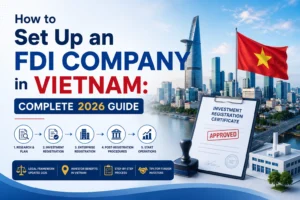
This guide explains the key conditions, documents, process, timeline and practical notes for foreign investors who want to set up an FDI company in Vietnam.
What is an FDI company in Vietnam?
An FDI company in Vietnam is a company with capital contributed by one or more foreign investors. It can be 100% foreign-owned or partly owned by foreign investors and Vietnamese investors.
Common forms include:
| Type | Suitable for | Note |
| LLC | SMEs, service businesses, consulting, IT | Simple structure |
| JSC | Companies planning to raise capital | At least 3 shareholders |
| Joint venture | Conditional business sectors | May need Vietnamese partner |
| BCC | Project-based cooperation | No new legal entity |
For most foreign SMEs, an LLC is the common choice because it is easier to manage and suitable for many service or trading models.

What changed for FDI company setup in Vietnam in 2026?
In 2026, Vietnam’s investment framework is more flexible. Under the 2025 Law on Investment, foreign investors may establish an economic organization before applying for or amending the Investment Registration Certificate in certain cases, but they still need to satisfy market access conditions.
This does not mean every FDI company can skip the IRC. The IRC may still be required for foreign-invested projects, conditional sectors, projects requiring investment approval, or projects in industrial zones and economic zones.
In short:
- Some cases may follow an ERC-first approach.
- Some cases still need IRC before implementation.
- Market access conditions must be checked before registration.
- The process should be reviewed case by case.
Virtual Office for Foreign Companies in Vietnam: Legal Guide & FDI Setup 2026

What are the two ways to set up an FDI company in Vietnam?
Foreign investors usually have two options: set up a new FDI company or contribute capital to an existing Vietnamese company.
| Method | Suitable for | Key point |
| Set up a new FDI company | New market entry, 100% foreign-owned company, subsidiary | Clear structure from the beginning |
| Contribute capital / acquire shares | Buying into an existing Vietnamese company | Faster in some cases, but needs due diligence |
A new FDI company is suitable when investors want clear ownership, clean records and full control from the beginning.
Capital contribution or share acquisition can be faster, but investors must check the target company carefully. Important points include tax history, debts, contracts, employees, business lines and foreign ownership limits.
What are the conditions to set up an FDI company in Vietnam?
Foreign investors need to check business lines, market access conditions, capital, legal representative, documents and registered office address.

1. Business lines and market access
Foreign investors must check whether the intended business sector is open, conditional or restricted.
| Sector group | Examples | Note |
| Open sectors | Consulting, IT, software, management services | Usually easier to register |
| Conditional sectors | Trading, retail, logistics, education, real estate | May need extra license |
| Restricted sectors | Sensitive sectors related to security or public order | Limited or prohibited |
Trading and retail activities may require additional business licenses after company registration. This should be checked early because it can affect timeline, capital and office requirements.
2. Registered office address
A registered office address is required for company registration in Vietnam. This address is used for licensing, tax notices, bank verification and official correspondence.
A suitable office address should have:
- Clear address information.
- Lease agreement or service agreement.
- Legal use for business registration.
- Mail receiving ability.
- Professional business image.
Many foreign investors lose time because the registered address is not accepted or cannot provide proper documents. Replus’ Vietnamese article also highlights that invalid business addresses can delay the setup process and positions virtual office as a solution for FDI companies.
Replus supports foreign investors with legal business address, mail handling, reception, company name display and flexible upgrade options from virtual office to coworking or serviced office.
3. Capital
Vietnam does not set one fixed minimum capital for all FDI companies. However, the capital must be suitable for the business line and operating plan.
Investors should understand:
| Term | Meaning |
| Charter capital | Capital contributed by members or shareholders |
| Investment capital | Total capital used for the investment project |
If the capital is too low, the authority may request explanation. If it is too high, investors must be ready to contribute it on time.
4. Legal representative and beneficial owner
The legal representative signs documents and works with authorities, banks and service providers. This person can be Vietnamese or foreign, depending on the company structure.
Foreign investors should also prepare beneficial ownership information. Vietnam’s amended Enterprise Law from 2025 introduced clearer requirements on collecting, updating and retaining beneficial owner information.
What documents are required to register an FDI company?
Required documents depend on whether the investor is an individual or a foreign company. Most foreign documents must be translated into Vietnamese, notarized and legalized before submission.
| Investor type | Main documents |
| Foreign individual | Passport, proof of financial capacity if required, proposed company name, business lines, office address documents, company charter, application forms |
| Foreign company | Certificate of Incorporation, company charter, financial statements or bank confirmation, decision to invest, appointment letter, passport of authorized representative |
| Office address | Lease agreement or service agreement, building/address information, provider information if using virtual office or serviced office |
Investors should prepare documents early. Legalization and translation often take more time than expected.
Cần tư vấn không gian làm việc?
Chia sẻ nhu cầu, Replus sẽ đề xuất phương án phù hợp.
Thông tin liên hệ
How to set up an FDI company in Vietnam?
To set up an FDI company in Vietnam, investors need to check conditions, prepare documents, register the company, complete investment procedures if required, and finish post-registration tasks.

Step 1: Check business lines
Confirm the intended business activities first. Investors need to know whether the sector is open, conditional or restricted, and whether foreign ownership is limited.
Step 2: Choose the investment method
Choose between setting up a new FDI company or contributing capital to an existing Vietnamese company. For new companies, common structures are LLC, JSC or joint venture.
Step 3: Prepare documents and office address
Prepare investor documents, company information and registered office documents. If using foreign documents, complete translation, notarization and legalization before submission.
Step 4: Apply for ERC and IRC if required
The Enterprise Registration Certificate – ERC confirms the legal establishment of the company. The Investment Registration Certificate – IRC records information about the investment project.
In 2026, the ERC/IRC order should be checked case by case because some cases may allow company registration before investment registration.
Step 5: Open bank accounts and contribute capital
After registration, the company may need a corporate bank account and a Direct Investment Capital Account – DICA. DICA is commonly used to receive foreign direct investment capital.
For capital contribution or share acquisition, an Indirect Investment Capital Account – IICA may apply in some cases. Investors should confirm the correct account type before transferring capital.
Step 6: Complete post-registration tasks
After receiving registration documents, the company should complete:
- Tax declaration.
- E-invoice registration.
- Digital signature/token.
- Accounting setup.
- Capital contribution.
- Sub-license application if required.
- Office operation setup.
This stage is important because the company cannot operate smoothly with ERC/IRC alone.
How long does it take to set up an FDI company in Vietnam?
The timeline depends on the investment method, business sector, document preparation and IRC requirements.
| Case | Estimated timeline |
| New FDI company with IRC | 30–60 working days or longer |
| Capital contribution / share acquisition | Around 20–35 working days |
| Conditional business sectors | Longer due to sub-license review |
| Post-registration setup | 1–3 weeks |
These timelines are for reference only. Education, logistics, retail, real estate and healthcare projects may take longer.
How much does it cost to set up an FDI company in Vietnam?
The cost depends on investor type, business line, licensing complexity, document legalization, office address and post-registration services.

Common cost items include:
- Government fees.
- Translation and notarization.
- Consular legalization.
- Legal or corporate service fees.
- Registered office address.
- Accounting and tax setup.
- Bank account support.
- DICA/IICA setup.
- Digital signature.
- Sub-license fees if required.
- Monthly workspace cost.
Investors should not compare only registration fees. The real cost includes legal setup, compliance, banking and office readiness.
What mistakes should foreign investors avoid?
Foreign investors should avoid these common mistakes:
- Choosing the wrong business line.
- Using an unsuitable registered office address.
- Preparing incomplete or untranslated documents.
- Registering capital that does not match the business plan.
- Forgetting DICA, tax, invoice and accounting setup.
- Starting business activities before required licenses are completed.
The two most common issues are business line mismatch and office address problems. These can delay the whole setup process.
FDI company vs representative office: Which option is better?
An FDI company is suitable when investors want to conduct business, sign contracts, issue invoices and generate revenue in Vietnam. A representative office is suitable for market research and liaison activities only.
| Criteria | FDI company | Representative office |
| Conduct business | Yes | No |
| Generate revenue | Yes | No |
| Issue invoices | Yes | No |
| Market research | Yes | Yes |
| Compliance | Higher | Lower |
| Best for | Real business operation | Market entry research |
If the goal is to sell products or services in Vietnam, an FDI company is usually the right choice.
Cần tư vấn không gian làm việc?
Chia sẻ nhu cầu, Replus sẽ đề xuất phương án phù hợp.
Thông tin liên hệ
How Replus supports foreign investors setting up in Vietnam
Replus supports foreign investors with registered office address, virtual office, coworking space, serviced office, meeting room and business support solutions.
Foreign investors can use Replus to solve the first practical problem: having a legal business address before building a full team in Vietnam.
Replus can support:
- Legal business address.
- Lease or service agreement.
- Mail and parcel handling.
- Reception support.
- Company name display.
- Meeting room access.
- Coworking space.
- Serviced office when the team grows.
- Business support for company setup, tax, accounting and bank account assistance.
This helps new FDI companies start lean, reduce fixed office costs and upgrade the workspace when operations expand.
Need a legal registered office address before setting up your FDI company in Vietnam? Contact Replus for virtual office, coworking space and serviced office solutions.
Conclusion
Setting up an FDI company in Vietnam is easier when investors prepare the right business line, investment method, capital plan, documents and office address from the beginning.
The registered office address is one of the first practical steps. It affects company registration, tax notices, bank verification and business image.
Contact Replus today to get a legal registered office address and flexible workspace solution for your FDI company in Vietnam.
[Hotline: 0932 678 626]
[Email: info@replus.com.vn]

Tư vấn và giải đáp thắc mắc
Đặt câu hỏi và nhận trả lời từ chuyên gia Replus
Cảm ơn bạn đã gửi câu hỏi!
Câu hỏi của bạn đã được gửi thành công và đang chờ kiểm duyệt. Chúng tôi sẽ hiển thị sau khi xác nhận.
Chưa có câu hỏi nào. Hãy là người đầu tiên đặt câu hỏi!

Dịch vụ giải thể doanh nghiệp trọn gói: quy trình, hồ sơ và thời gian theo quy định 2026
Dịch vụ giải thể doanh nghiệp của Replus hỗ trợ công ty TNHH, công ty cổ…

Thành lập công ty tại Việt Nam từ xa cho nhà đầu tư nước ngoài
Nhà đầu tư nước ngoài có thể thành lập công ty tại Việt Nam từ xa…

How To Set Up A Representative Office In Vietnam 2026
Setting up a representative office in Vietnam is a practical option for foreign companies that want…
![Thủ tục thành lập công ty có vốn nước ngoài trọn gói: Điều kiện và hồ sơ [2026]](https://replus.com.vn/wp-content/uploads/2026/06/danh-sach-cac-doanh-nghiep-co-von-nuoc-ngoai-tai-binh-duong.webp)
Thủ tục thành lập công ty có vốn nước ngoài trọn gói: Điều kiện và hồ sơ [2026]
Thành lập công ty có vốn nước ngoài tại Việt Nam đòi hỏi nhà đầu tư…
Danh sách văn phòng công chứng Sài Gòn theo khu vực và phường mới
Tính đến ngày 30/6/2026, TP.HCM có 196 tổ chức hành nghề công chứng, gồm 11 Phòng…
![Dịch vụ thành lập công ty, doanh nghiệp giá rẻ trọn gói [Cập nhật 2026]](https://replus.com.vn/wp-content/uploads/2022/06/thanh-lap-cong-ty-02-1024x506.jpg)
Dịch vụ thành lập công ty, doanh nghiệp giá rẻ trọn gói [Cập nhật 2026]
Hồ sơ, thủ tục đăng kí dịch vụ thành lập công ty được soạn thảo đầy…

Dịch vụ thành lập công ty TPHCM trọn gói, giá SIÊU rẻ
Thành lập công ty TPHCM không phải là một quá trình phức tạp nếu bạn nắm…

Hướng dẫn chi tiết quy trình thành lập công ty Lạng Sơn
Việc thành lập công ty Lạng Sơn đòi hỏi sự nắm rõ về quy trình và…
